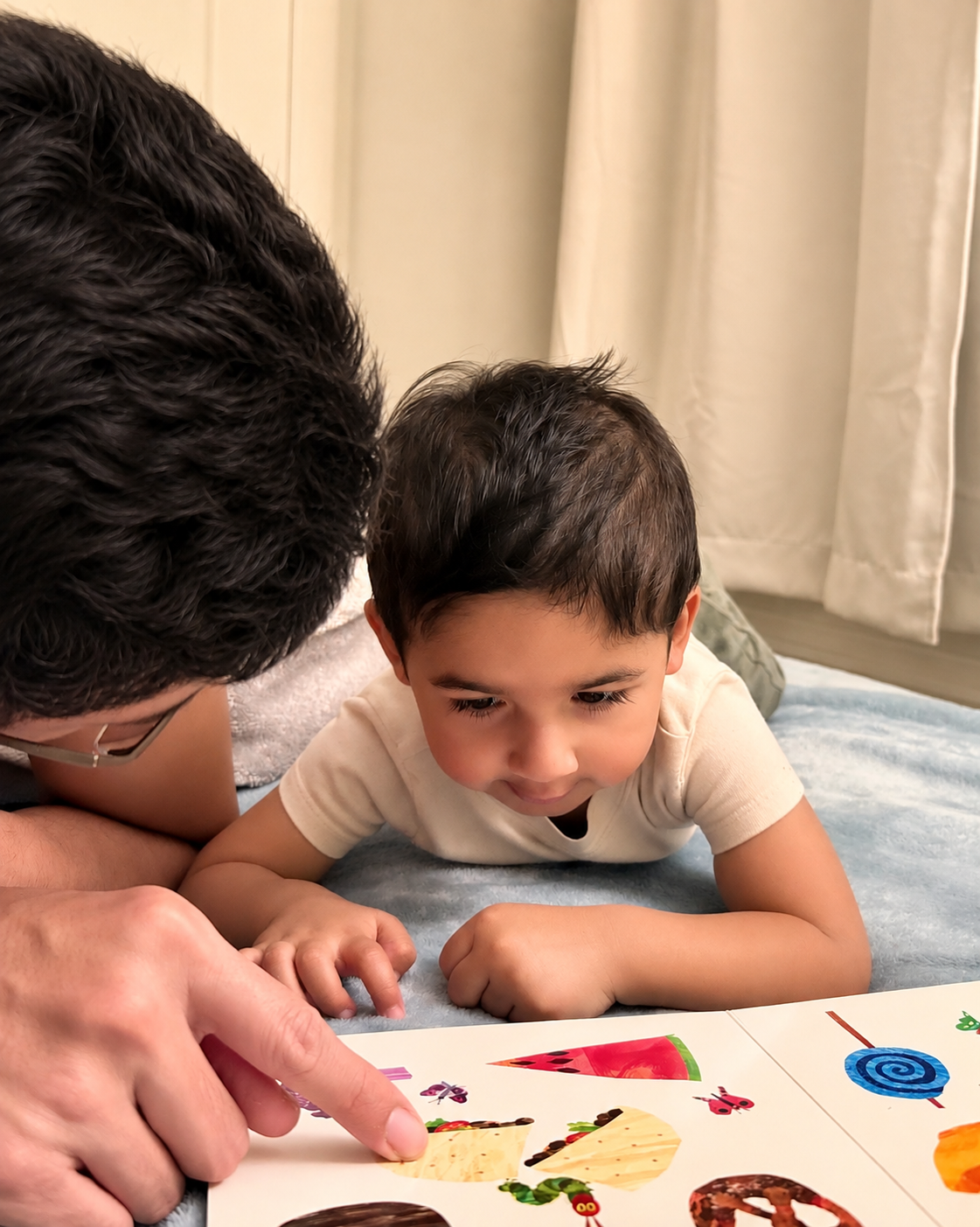
I once wondered what a five-day-old baby could possibly do with a book. Twenty-two months later, Duggu has his own favorites, recognizes familiar stories, and sometimes asks us to read when he is tired. I did not see that coming.
Our book collection started with a few simple black-and-white cards. Since then, we have tried different kinds of books, discovered what holds Duggu’s attention, and learned that the right book often depends on the stage he is in.
This is not a list of “must-have” books for every child. These are books and formats that became part of our family’s routine. At the end of each age section, I have linked the matching Little Learning Library Idea List, where I keep the full collection for that stage.
Some links in this article may be affiliate links. If you buy through them, I may earn a small commission at no extra cost to you.
0–6 Months | First Books | Little Learning Library
When Duggu was just five days old, my wife introduced him to black-and-white contrast cards. I was skeptical. I kept wondering what a newborn could actually see.
One morning, he woke up in his SNOO bassinet and seemed interested in the black-and-white camera attached to it. We brought out the contrast cards, and he looked toward them too. It was a small moment, but it made me more interested in introducing books early.
Crinkle books came soon after. Their sounds and textures gave him something simple to explore. We tried using them during tummy time, although I cannot say they made tummy time any easier.
At this stage, I would keep things simple. High-contrast cards, soft books, and crinkle books are more than enough. There is no need to expect a newborn to sit through a story or interact with every page.
See the full collection: 0–6 Months | First Books | Little Learning Library
6–12 Months | Touch, Feel & Explore | Little Learning Library
As Duggu grew, books became more interactive. He started exploring textures, pictures, and flaps rather than simply looking at them.
We introduced farm-animal touch-and-feel books, including Pet the Animals. At first, he did not quite understand what to do with the textured pages. We would guide his hands over the different surfaces and point out the animals.
That stage showed me that a book does not need a long story to be interesting. A texture, a sound, or a surprise on the next page can be enough.
We also tried lift-the-flap books. One thing I learned: a board book does not mean its flaps are indestructible. Duggu managed to tear some of them, so I would not spend extra money expecting every interactive book to survive toddler handling.
If a book has flaps, pop-ups, or delicate textures, expect closer supervision and a shorter lifespan.
See the full collection: 6–12 Months | Touch, Feel & Explore | Little Learning Library
12–18 Months | First Words & Picture Books | Little Learning Library
Around this age, familiar pictures, repetition, and simple stories became more interesting to Duggu.
One book that worked well for us was The Very Hungry Caterpillar. The bright illustrations, food, counting, and simple story gave him plenty to look at. It is also a book that can grow with a child: first they notice the pictures, then point to familiar foods, and later begin to follow the sequence.
At this age, I would look for clear pictures, familiar objects or animals, and simple language. You do not need a long story. Sometimes a few pages are enough for one sitting.
See the full collection: 12–18 Months | First Words & Picture Books | Little Learning Library
18–24 Months | Toddler Storytime | Little Learning Library
As Duggu got older, he began showing stronger preferences. One book that has stayed in rotation is Little Blue Truck. He enjoys the animals, vehicle sounds, and the familiar rhythm of reading it together.
Not every book gets the same reaction, and that is part of figuring out what your child enjoys. Some days he wants a familiar story; other days he picks something different.
At this stage, books with animals, vehicles, repeated phrases, gentle bedtime rhythms, or memorable characters can give toddlers more reasons to return to a story.
See the full collection: 18–24 Months | Toddler Storytime | Little Learning Library
Indian Stories & Shlokas | Little Learning Library
We wanted Duggu to grow up with stories that reflected our culture too. Family in India brought children’s mythology books, and my wife bought shloka books.
Recently, we introduced him to a Baby Krishna story about Govardhan Parvat. He enjoys it and sometimes chooses it himself.
These books came from India, so I do not have storefront links for them here. I also own longer mythology stories, but some are still too advanced for him. Looking back, I would have waited before buying those. A book can be lovely and still not be right for a child’s current stage.
For young children, I would start with shorter stories, clear illustrations, and familiar characters rather than buying a large collection of longer retellings at once.
Do You Need to Spend a Lot on Baby Books?
Not really. We built our collection gradually through research, Amazon suggestions, and recommendations from friends. Some books became regular favorites; others did not hold Duggu’s attention for long.
If I were starting again, I would buy fewer books at a time and pay more attention to the stage Duggu was in. A few sturdy board books, one interactive book, and a couple of simple picture books are enough to learn what your child enjoys. I would also avoid buying too many books just because they are popular online. Children develop their interests at different speeds, and a book that works wonderfully for one child may not interest another.
How Reading Became Part of Our Routine
We never followed a strict reading schedule. Books became part of our day naturally.
At bedtime, we often reach for storybooks, familiar favorites, or Baby Krishna stories. During the day, we bring out picture books and learning books when Duggu is interested. Daycare has also given him more opportunities to explore books.
One of my favorite changes has been seeing him reach for a book himself. I have written more about the time he asked for a book after daycare : How One Bedtime Book Changed My Tired Evening
What I Would Do Differently
If I were starting this collection again, I would buy fewer books at a time and avoid treating every popular recommendation as a must-have.
Most importantly, I would not worry about finishing every story or following a perfect reading routine. A few pages together still count.
FAQs
When should I start reading to my baby?
You can introduce books from the newborn stage. High-contrast cards and simple picture books are an easy place to start. Keep it relaxed and follow your baby’s interest.
What kind of books are best for babies?
High-contrast cards, soft or crinkle books, touch-and-feel books, and sturdy board books are useful starting points. As your child grows, picture books and simple stories can become more interesting.
How many books does a baby need?
There is no set number. A small collection with a few different formats is enough to begin. Add more as your child’s interests develop.
How do I get my toddler interested in books?
Choose books with pictures, repetition, familiar subjects, or interactive features. Read when your child is receptive, and let them choose a book sometimes. It does not need to become a forced activity.
Are board books better than paperback books for toddlers?
Board books are usually easier for babies and young toddlers to handle every day. Paperback books can still be wonderful, but they may need more supervision until your child is gentler with pages.
Final Thoughts
Our book collection has grown alongside Duggu. From contrast cards when he was just a few days old to stories he now chooses himself, reading has become a familiar part of family life.
If you are building your baby’s first library, start small, follow your child’s interests, and give books time. You may be surprised by which ones become their favorites.
Related reading:
Leave a Reply